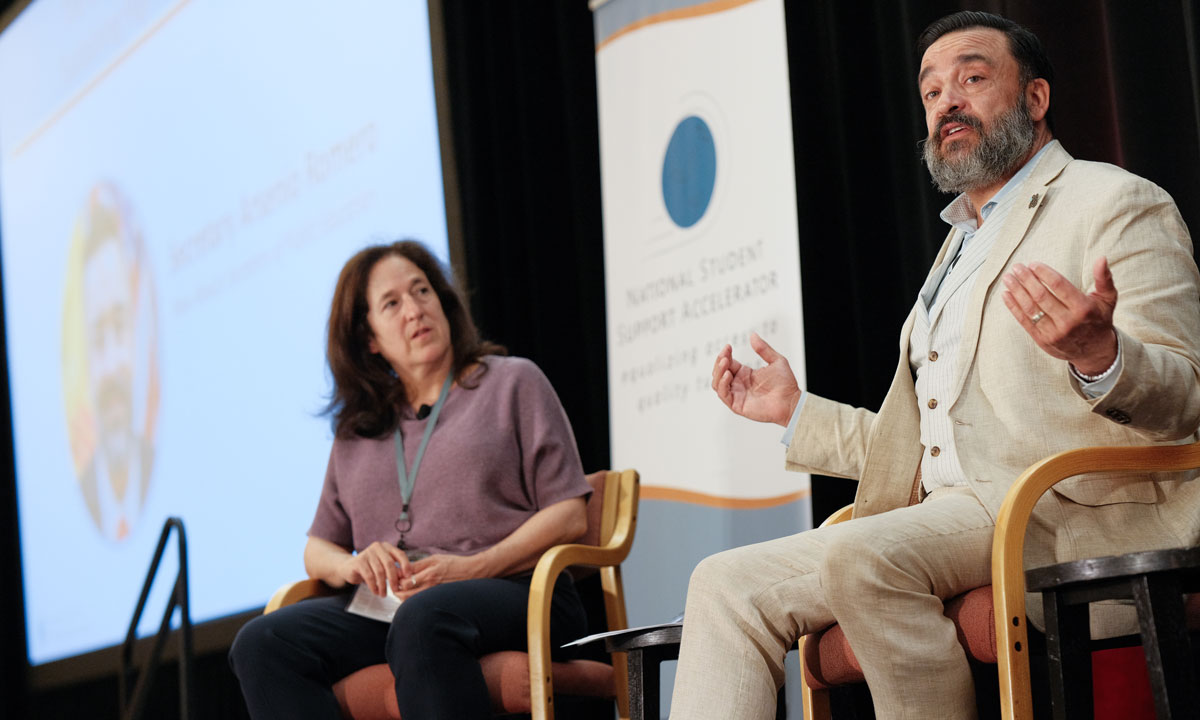
Researcher

Implementation of the OSSE High Impact Tutoring Initiative: First Year Report School Year 2022 – 2023

The District of Columbia (DC) Office of the State Superintendent of Education (OSSE) launched a three-year, $33 million investment in scaling and supporting high-impact tutoring (HIT) across DC, with a particular focus on students classified as “at-risk” or having experienced disrupted instruction during the COVID-19 pandemic. This investment is a core part of the city’s strategy to address interrupted schooling, given the strong body of evidence demonstrating the effectiveness of HIT as an intervention that can produce dramatic gains in student learning.

Reimagining Tutoring: Evidence-Backed Strategies to Boost Student Learning, School Culture & Educator Satisfaction

In the admirable rush to support students in the wake of pandemic-era learning loss, schools quickly implemented tutoring initiatives—with varying degrees of success.

Luckily, studies show that students who participate in high-impact tutoring can experience more than 40% and 200% of growth in reading and math proficiency, respectively. Meanwhile, K-12 leaders say this form of tutoring is increasing teacher retention and recruitment in their districts.

In this webinar, education leaders will hear first-hand accounts of successful high-impact tutoring models from a district’s chief academic officer. Also, field research experts from institutions, including Stanford University, and professionals who collaborate directly with district decision-makers will present case studies and stats on how to sustain high-impact tutoring to make a lasting effect on student learning, school culture, and educator job satisfaction.

What Educators Are Saying about High-Impact Tutoring

What do teachers have to say about high-impact tutoring? Teacher buy-in is of vast importance when implementing high-impact tutoring into the school day. Who would know the benefits of High-Impact Tutoring better than educators? Hear from them directly about what makes effective tutors, the importance of building strong relationships, and why representation matters.

NSSA's Educator Tutoring Advisory Group (Maurice Telesford, Estefania Rios, Toni Hicks, and Katie Allen) are saying about High-Impact Tutoring

Eye on Education: The American tutoring revolution

Notably, research by Susanna Loeb (Stanford University) revealed that tutoring methods and strategies can vary dramatically both in their design features and student outcomes. Loeb’s team of researchers discovered that in particular “high impact” tutoring strategies have demonstrated statistically significant effects on student learning in math and reading. High impact tutoring contains the following features:

  • One-on-one tutoring (or with very small groups)
  • Tutoring content is aligned with in-class instruction
  • Students receive tutoring at least three times per week from the same tutor
  • Tutors are professionally trained 
Tags

PROOF POINTS: New studies of online tutoring highlight troubles with attendance and larger tutoring groups

Another study of more than 2,000 elementary school children in Texas tested the difference between one-to-one and two-to-one online tutoring during the 2022-23 school year. These were young, low-income children, in kindergarten through 2nd grade, who were just learning to read. Children who were randomly assigned to get one-to-one tutoring four times a week posted small gains on one test, but not on another, compared to students in a comparison group who didn’t get tutoring. First graders assigned to one-to-one tutoring gained the equivalent of 30 additional days of school. By contrast, children who had been tutored in pairs were statistically no different in reading than the comparison group of untutored children. A draft paper about this study, led by researchers from Stanford University, was posted to the Annenberg website in May 2024. 

Tags

Design Principles for Accelerating Student Learning With High-Impact Tutoring

Research consistently shows that tutoring helps students learn, with numerous studies confirming its strong benefits. Driven by this evidence, policymakers and educational leaders nationwide are investing in tutoring initiatives. However “tutoring” can mean various types of educational support, and tutoring programs can differ significantly in their characteristics and effectiveness.

How Districts Can Keep High-Impact Tutoring Going After ESSER Money Expires

Loeb & Safran: From Title I and Americorps to apprenticeships and renegotiated contracts with vendors, ways to find replacement funds and economize. strong>Multi-Tiered Systems of Support: Districts across the nation use Multi-Tiered Systems of Support to target appropriate interventions for students with learning, social, emotional, or behavioral difficulties. Many districts could improve these offerings by using a high-impact tutoring approach, making sure their interventions build relationships between students and educators that motivate, engage and target students’ growth areas using data and high-quality instructional materials. Schools can integrate high-impact tutoring with the funds already being used for MTSS by reallocating resources to more effective approaches.
Tags

Applying Lessons from Advocacy Research to Expand Tutoring in Public Education


What led to the rapid spread and adoption of tutoring as a solution? What will it take to bring tutoring to the scale? And what can the science of advocacy teach us about how other policy ideas might follow a similar path? In this AdvocacyLabs webinar, FutureEd Policy Director Liz Cohen will moderate a discussion with panelists including Stanford University Professor Susanna Loeb, JerseyCAN Executive Director Paula White, and 50CAN CEO Marc Porter Magee.