State level actions can accelerate the adoption of high-impact tutoring, expanding access to this highly effective learning acceleration approach for California students across the state.
High-impact tutoring is one of the most effective tools available for accelerating student learning. This brief lays out state-level actions that can expand access to it across California, building on the interest, investment and early success already underway in districts and county offices statewide. The outcomes below show why this work is important now.
The Need to Accelerate Student Learning1
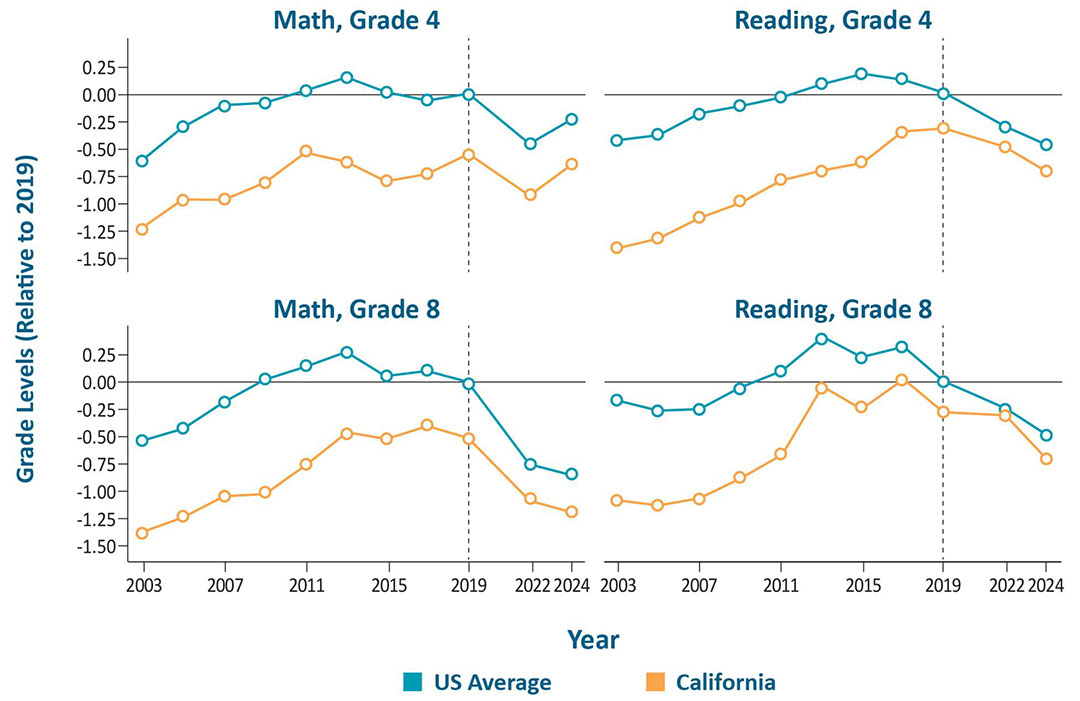
California public schools serve just under 5.8 million students, a large and diverse population that includes over 1 million English learners, homeless youth (roughly 4% of enrollment),2 and students with learning differences (roughly 15% of enrollment).3 Student outcomes in California have improved relative to national averages, but outcomes still lag the national average (see Figure 1) with 29% of 4th graders and 28% of 8th graders scoring proficient in reading and only 35% of 4th graders and 25% of 8th graders scoring proficient in math and the gap between poor and non-poor students remains high including a gap of 3.2 grade levels in math, an increase of about 13% since 2015.4
Engagement in school is also improving, yet still challenging. While chronic absenteeism fell to 19.4% in 2024-25, the rate remains nearly double the pre-pandemic level of 12.1%. Additionally, roughly half of California high school students do not feel connected to school or to a caring adult and nearly 80% do not feel engaged in meaningful learning.5
These outcomes show that evidence-based, scalable strategies are needed to produce measurable gains in learning and engagement.
The Potential of High-Impact Tutoring to Accelerate Student Learning
Intensive, relationship-based, individualized instruction - or high-impact tutoring6 - has the strongest evidence base for catching up students when they struggle, while also improving engagement and attendance. The additional six months to over two years of learning that students gain for a year of tutoring makes tutoring more effective than other researched interventions.7 New studies continue to validate the efficacy of high-impact tutoring for accelerating student learning while identifying more cost-effective and scalable implementation approaches. Recent research shows that virtual tutoring with a human tutor can also be effective,8 which broadens opportunities for students in rural LEAs and for LEAs looking for tutoring in harder-to-staff content areas such as high school math. Additional studies have shown that short bursts of individualized literacy instruction can be effective with younger students supporting a less-expensive, more scalable approach. Artificial intelligence to support tutoring is also showing promise in reducing administrative load and supporting tutor effectiveness.
Research and proof points also identify valuable spillover effects. A recent study found that high-impact tutoring not only boosts academic performance but also improves student attendance, particularly among middle schoolers and those who are chronically absent.9 This dual impact highlights high-impact tutoring as a promising strategy for enhancing both learning and student engagement, especially in efforts to reduce chronic absenteeism. Additionally, many programs from Guilford County Schools, NC, to Springfield City School District, OH, to Los Angeles Unified School District, CA use college students as tutors, an approach that provides a renewable source of tutors, combined with the potential to provide college students with valuable skills and expand the educator pipeline.
Student needs, compelling research, and the innovative efforts of educators and others have dramatically increased students’ access to high-impact tutoring. A recent survey found that 45% of principals reported providing high-intensity tutoring in the first full school year without pandemic relief funds. In high-poverty schools, that number was 64%.10 Many states now incorporate high-impact tutoring into education policy, and even require it for certain student groups.11
High-Impact Tutoring in California
While pockets of support and successful examples of high-impact tutoring exist across the state, California currently has no state-level policy, supports, or dedicated funding stream that specifically encourages high-impact tutoring adoption. Momentum is nonetheless building at both the state and LEA level.
Interest in high-impact tutoring at the state level began during the pandemic, when leaders from the California Department of Education (CDE), the California Collaborative for Educational Excellence (CCEE), and the State Board of Education (SBE) began exploring how to encourage California LEAs to adopt high-impact tutoring.
This interest led to the California High-Impact Tutoring Solutions Sprint, an 8-session virtual learning initiative led by Results for America (RFA) and the National Student Support Accelerator (NSSA), in collaboration with the CDE, CCEE, and SBE. The Sprint brought together teams from 30 participating LEAs, charter schools, and county offices of education to design and implement evidence-based tutoring programs, with access to peer learning and technical assistance throughout the process.
Additional signals of state-level interest include State Superintendent Tony Thurmond's Literacy Moonshot which names high-impact tutoring as key strategy and recognition of high-impact tutoring’s effectiveness through the LAUSD Shaw settlement, which requires high-impact tutoring for current LAUSD students who attended LAUSD during the 2020-21 and 2021-22 school years.
LEA demand for tutoring is strong and well-documented. More than 80% of Local Control and Accountability Plans (LCAPs) statewide include some form of tutoring, signaling broad recognition among LEA leaders that tutoring is a priority strategy for accelerating student learning.
Proof points from LEAs across the state, from Portola to San Diego show that LEAs can implement high-impact tutoring successfully within California's existing governance and funding structures, even absent state-level mandates or dedicated funding.
While California has no funding stream specifically designated for high-impact tutoring, LEAs can use, and are using, several existing sources to support high-impact tutoring implementation. The primary funding sources supporting high-impact tutoring in California include the Expanded Learning Opportunities Program (ELO-P), the Learning Recovery Block Grant, and California College Corps, which funds college students to serve as tutors in K-12 settings. The most recent state budget also included a $5 million allocation for Reading and Math Corps12 high-impact tutoring programs.
High-impact tutoring in California is at an inflection point. Interest is high among state and LEA leaders, and proof points demonstrate that the model works within California's context.
The Purpose and Design of this Report
As part of the California High-Impact Tutoring Solutions Sprint, and at the request of CDE, CCEE, and SBE, the National Student Support Accelerator (NSSA) conducted qualitative research to better understand the barriers and facilitators to implementing high-impact tutoring across California. The goal of this research is to provide recommendations for state-level actions that could improve conditions for wider scale adoption across the state.
These recommendations draw on three sources of evidence collected through the Sprint process:
Sprint onboarding and exit surveys
Results for America and NSSA offered a free, 8-week High-Impact Tutoring Solutions Sprint (Sprint) from October through December 2025. To be selected, applicants had to be a California district, charter school, or county office of education, and to commit a team, including, at minimum, an academic and a financial decision-maker, to participate in the eight virtual learning sessions. Thirty teams participated in the Sprint.
In total, 28 team leads completed the onboarding survey, representing 15 districts, seven charter schools, and six county offices of education, and covering a total of over 165,000 students. Eighteen team leads completed the exit survey, representing eight districts, three charter schools, and seven county offices of education, and covering over 120,000 students.
Interviews with Sprint participants
NSSA requested interviews with all 28 team leads who completed the onboarding survey. NSSA, in partnership with Texas A & M’s Bush School of Government and Public Service completed 11 interviews, representing six districts, two charter schools and three county offices of education, and covering over 110,000 students.
Observation and interaction with Sprint participants
Throughout the Sprint, and through a review of teams' final presentations, NSSA collected additional information on participants' implementation experiences, decision-making processes, and outcomes.
Note: NSSA recognizes that this data is not representative of LEAs across the state of California. To supplement this data, NSSA also draws on its experience working with LEAs and states nationally, as well as broader tutoring research, including Challenges and Solutions to Implementing Tutoring at Scale and Best Practices for States Supporting High-Impact Tutoring.
Barriers and Facilitators to LEA Adoption of High-Impact Tutoring: Lessons from a National Perspective
Based on existing research and NSSA's experience working with LEAs and states nationally, several barriers and facilitators shape LEA adoption of high-impact tutoring.
Barriers
Definition and Standards: High-impact tutoring requires specific principles that LEAs can find challenging to integrate into their school programming. Research shows that tutoring may not be effective without these principles.
Funding. Reliable and predictable funding poses a key challenge facing LEAs today. Many LEAs that used ESSER funding to launch their high-impact tutoring programs have found ways to sustain their programs through use of Title funds or state, federal, or philanthropic grants. Others have partnered with higher education institutions or apprenticeship programs to continue their programs. Even so, sustainable funding remains a significant challenge for many LEAs.
Scheduling. Scheduling tutoring during the school day is among the most significant challenges LEAs face, as within-school tutoring requires disrupting established routines. Elementary schools generally absorb this disruption more easily because students often stay in one classroom for most of the day and are accustomed to additional adults moving in and out. High schools, by contrast, operate on more rigid, period-based schedules, which makes it harder to build in the frequency of tutoring sessions students need.
Staffing. Recruiting and training tutors demands significant resources. LEAs often struggle to find sufficient qualified tutors and then provide training, ongoing oversight, and instructional materials to keep them effective.
Data systems. Data systems present another challenge. Tutors need data on student learning to target their instruction effectively; as without reliable data, tutors cannot adapt their sessions to meet individual students where they are. LEAs often struggle to align tutoring and school-based data and share it in a timely way.
Attendance. Ensuring students and tutors show up consistently can be challenging. Effective tutoring requires multiple sessions per week with a consistent tutor, yet research studies often find that LEAs deliver less than half of scheduled tutoring dosage in practice.13 This challenge grows especially pronounced in out-of-school programs that don't actively support attendance.
Facilitators
Despite these challenges, LEAs across many contexts implement high-impact tutoring with integrity. Drawing on research studies and NSSA's experience working with LEAs and states, we identify the following key facilitators of successful implementation across LEAs, providers, and organizations.
Supportive state policy. States that require or encourage high-impact tutoring as part of broader education goals give LEAs a stronger foundation for adoption. For example, Louisiana requires high-impact tutoring for K-5 students performing below grade level in mathematics or reading.
Funding availability and clarity. Tutoring-specific funding streams or clear guidance on what funding LEAs must, should, or may use for high-impact tutoring helps LEAs plan and sustain their programs.
Policy paired with funding. High-impact tutoring is more sustainable when states connect policy and funding. As an example, Tennessee requires literacy tutoring for fourth graders who did not meet expectations on the third-grade ELA assessment, and provides $500 for each of these students to fund the tutoring.
State or LEA supports. Clear expectations, state-specific toolkits and guidance, pre-approved tutoring vendor lists, and other tools and materials make it easier for LEAs to adopt or expand tutoring programs.
Educator belief. Most educators believe in tutoring's potential to work. They hold a fundamental belief that instruction tailored to a student's individual strengths and needs delivered by someone who knows them well and has high-quality materials can accelerate learning.
Policy, funding, supports, and educator belief create conditions that allow LEAs to take up tutoring at scale.
California Findings from the High-Impact Tutoring Solutions Sprint
This summary of tutoring efforts relies solely on Sprint participants and does not reflect a representative overview of tutoring efforts across the state.
Current and Planned Tutoring Efforts
Roughly half of the 28 LEAs that responded to the Sprint onboarding survey (46%) currently report offering evidence-based high-impact tutoring (sustained dosage of at least three sessions per week, group sizes of four or fewer students, alignment with core instruction, data-informed practice, and consistent tutor-student relationships), while a larger majority (69%) report offering some form of other tutoring, like drop-in support. Among the 13 LEAs offering high-impact tutoring, coverage concentrates heavily in K-8, with only two LEAs extending high-impact tutoring into high school. ELA dominates in early grades, while math and ELA balance out by middle school. LEAs deliver tutoring through a mix of Tier 1 instruction time, out-of-school time, and expanded learning time, with no single model dominating. Staffing relies mainly on LEA teachers and paraprofessionals, often paired together, with outside vendors supplementing about 54% of programs. No LEA reported using volunteers.
These same LEAs plan to expand high-impact tutoring significantly across every grade span, with high school showing the steepest relative growth (from two to 10 LEAs). LEAs plan to grow math tutoring faster than ELA in relative terms, closing a gap that currently favors ELA. For delivery, LEAs plan to shift more tutoring into expanded learning time and out-of-school time, while keeping Tier 1 instruction delivery flat. On staffing and structure, LEAs strongly favor building internal capacity (21 of 28 LEAs) over outsourcing, though many want outside help with curriculum and tutor training. Most LEAs (84%) plan to integrate high-impact tutoring into broader systems like MTSS, and plan to evaluate effectiveness using multiple measures, primarily teacher feedback and pre-post assessments.
California-Specific Barriers and Facilitators
Findings from Sprint participant surveys and interviews are largely consistent with national patterns.
Barriers
Sprint participants voiced consistent, overlapping barriers across stages of implementation.
Common language: The "tutoring" language itself creates confusion. Multiple interviewees independently raised concern that the word "tutoring" carries misleading connotations, implying optional, after-school homework help rather than a structured instructional intervention. As one interviewee put it, the label leads staff to assume "it's somebody else's job to do it," contributing to diffused ownership and inconsistent buy-in.
Capacity: Funding, especially sustainable and flexible funding, is the most commonly cited pain point in the exit survey, the top resource gap alongside training and materials in the onboarding survey, and the single most frequently mentioned barrier across the interviews. LEAs described relying heavily on time-limited sources such as ELO-P, community schools funds, and federal grants like AmeriCorps, several of which have already faced disruption or elimination. LEAs repeatedly noted that even where funding exists for screening or reading intervention, it rarely extends to the ongoing costs of tutoring, equipment, or expansion into math.
Staffing and tutor capacity constrain most programs. LEAs consistently reported difficulty recruiting and training enough tutors, particularly tutors with specialized skills such as bilingual instruction or secondary-level content knowledge. Where LEAs rely on existing teachers, they run into the same time constraints identified nationally; few teachers can commit to the frequency tutoring requires on top of a full classroom schedule. Where LEAs rely on outside vendors, they report turnover and inconsistent tutor quality.
Logistics: Ambiguous ownership and unclear communication undermine adoption. Several interviewees and survey respondents described LEAs introducing tutoring tools or mandates without clarity on who is responsible for requiring or overseeing their use. This shows up concretely: one LEA reported that fewer than 10% of students met a 30-minute weekly usage goal for an adaptive tutoring tool the LEA had initiated without a clear rollout plan. Where clarity existed, buy-in appeared to follow; one fully implemented program attributed strong buy-in directly to consistent, proactive communication with teachers throughout planning and rollout.
Scheduling remains especially difficult at the secondary level. Consistent with national findings, California Sprint LEAs report that embedding tutoring into elementary schedules is manageable, while secondary schedules, with their rigid, multi-period structure, make consistent tutoring far harder to sustain. Several LEAs noted that secondary tutoring remains largely self-referral or drop-in, reaching only a small fraction of students.
Student attendance, particularly outside the school day, continues to limit impact. Interviewees described attendance as inconsistent at best for after-school and opt-in models, with transportation, split-household logistics, and competing family obligations cited as major contributing factors. This mirrors the national finding that opt-in and out-of-school tutoring disproportionately fails to reach the students who need it most.
Data: Data systems need further development. Across both surveys, LEAs most commonly cited difficulty choosing what data to track and lacking any clear system for collecting tutoring-specific data, separate from general attendance or academic records. Several interviewees also raised concern about the absence of standardized ways to evaluate program effectiveness or compare vendors, leaving LEAs to build evaluation frameworks from scratch or, in at least one case, rely on vendor-reported metrics later found to be inflated.
Facilitators
California Sprint LEAs benefit from several conditions that support early tutoring implementation.
Champions: Leadership-level buy-in is generally strong. Across the onboarding survey, LEA-level buy-in was the single resource respondents felt most confident in - rated lowest in need of additional support of any category measured. Interviewees echoed this: LEA and county leaders consistently expressed belief in tutoring's effectiveness, and several described "astounded" reactions to early outcome data comparing tutored and non-tutored students.
Supportive systems: LEAs are leveraging existing infrastructure and relationships to ease adoption. Several LEAs reduced implementation friction by building on tools and structures already familiar to staff and students, such as adopting a screening tool already in use for tutoring purposes, or embedding tutoring into existing instructional coaching networks that meet with teachers monthly. Interviewees similarly emphasized that long-standing school relationships and data-sharing habits made student identification easier once a program launched, and that partnerships spanning a school LEA, PTA, and city government sustained programming without a single formal funding source.
Literacy implementation success: ELA implementation is more prevalent. Both surveys and interviews point to ELA as the subject where Sprint participants made the most progress: it leads math in current tutoring availability across every grade span, and multiple LEAs described having reliable systems for identifying students needing reading intervention, in some cases well ahead of comparable systems for math.
Commitment: Growth intentions among Sprint participants are strong and specific. LEAs are not just continuing existing programs; they are actively planning to expand into underserved grade spans (especially high school) and subjects (especially math), with planned offerings roughly doubling or more across nearly every grade span and subject combination.
Proof points: Positive outcomes are already emerging where programs are running. Multiple interviewees and survey respondents reported measurable gains in student engagement, confidence, and academic performance, along with unexpected benefits such as increased peer-to-peer learning and stronger sense of belonging among student subgroups.
Recommendations for State Support
Drawing on national research and Sprint findings, the following state-level actions can ease current implementation challenges and expand access to high-impact tutoring for students across California. Funding ranked as the top barrier across every data source in this study, so the funding recommendations below represent the high-priority lever for state action
Policy
Define tutoring using research-backed characteristics, and build that definition into broader policy. Education leaders and practitioners across California currently use "tutoring" as an umbrella term that covers everything from drop-in homework help to structured, high-dosage instruction. The state could adopt a clear, research-backed definition of high-impact tutoring and embed it directly into major policy vehicles already in motion, such as the Literacy Moonshot and the new Mathematics Framework.
Expand current literacy and math policy to include high-impact tutoring. Connecting high-impact tutoring to existing policy as an encouraged support for students identified by screeners or other systems as in need of additional support helps LEA staff understand that tutoring is part of a coherent instructional program.
Start with a pilot: co-design and implement with a range of committed districts, and align it with broader education initiatives. Piloting with a committed cohort lets the state test funding mechanisms and quality guardrails before scaling statewide, while tying implementation to broader initiatives, such as the Math Framework builds on momentum LEAs already have around math instruction.
Funding
Provide multi-year, dedicated funding streams. Funding ranked as the top barrier across every data source in this study. LEAs asked for funding that lasts several years so they can plan, and for funding that extends beyond screening and into ongoing support costs. Embedding or encouraging high-impact tutoring as a use of existing funding streams or adding dedicated state funding to supporting high-impact tutoring would give LEAs more confidence to provide high-impact tutoring for their students.
Guidance
Guidance can operate at different levels of intensity — available through public sources such as the CDE website, encouraged through state level promotion such as webinars, convenings or inclusion in policy, or required through policy.
Issue clear guidance on which funding sources LEAs can use for tutoring and how. LEAs need a single, authoritative answer on how ELO-P, the Learning Recovery Block Grant, California College Corps, and other existing sources apply to tutoring specifically.
Publish a checklist or guide for implementing high-impact tutoring within ELO-P. Research is clear that tutoring outside of the school day creates attendance challenges making out-of-school models less reliable for the students who need tutoring most. California’s robust funding of ELO-P understandably encourages tutoring through ELO-P. California can meet that reality with guidance to ensure ELO-P-based tutoring is aligned with research-backed principles.
Provide guidance on integrating tutoring into MTSS. Many Sprint LEAs plan to fold tutoring into their MTSS structures; state guidance can help them do this consistently rather than reinventing the approach district by district.
Capacity-Building and Infrastructure
The recommendations below call for the state to build and maintain shared tools and systems, a heavier lift than issuing guidance, but one that removes work individual LEAs would otherwise duplicate.
Develop a California-specific LEA playbook for implementing tutoring with quality. Given LEAs' strong interest in growing their own tutoring programs, a state-specific playbook can give districts a concrete model for designing, evaluating, and improving programs.
Build shared infrastructure for tutor training, coaching, and quality materials. LEAs rated tutor training and instructional materials as top resource gaps. The state could develop or vet training modules, curricular resources, and coaching models that individual LEAs may struggle to build individually.
Develop a list of approved tutoring providers. The state can review tutoring providers for quality, safety, and research-backed practices and publish an approved list to reduce duplicated effort and help LEAs avoid vendors with weak quality or inflated metrics.
Offer model scheduling guidance tailored to secondary schools. Sprint participants and national research consistently identify scheduling as one of the most challenging barriers at the secondary level. The state could provide example master schedules and technical assistance focused specifically on building intervention blocks into multi-period high school schedules.
Support development of a shared data and evaluation framework. Sprint LEAs struggle to decide what tutoring-specific data to collect and lack standardized ways to measure effectiveness. The state could provide a lightweight, common framework or data dashboard template for tracking dosage, attendance, and outcomes — helping LEAs improve their own programs while building comparable, credible evidence of impact statewide.
Field Building / Shared Learning
Sprint participants consistently noted the value of shared learning across LEAs. State or County Office of Education supported shared learning may facilitate broader and more efficient adoption.
Add guidance, examples, and office hours to the CDE website. CDE could create an accessible hub for tutoring resources and connections with regular office hours for LEAs to ask questions directly.
Host a Professional Learning Community (PLC) for LEAs implementing tutoring. California LEAs value learning from each other; a state-convened PLC gives them a structured way to do that rather than relying on informal, one-off connections.
Establish a secure, cross-LEA platform for sharing strategies and vetted vendors. Multiple interviewees independently proposed a low-cost, email-verified forum limited to school district and county office staff, where LEAs could exchange curriculum recommendations, implementation strategies, and vendor experiences.
Conclusion
Achievement and engagement across California’s K-12 schools continue to lag. High-impact tutoring is proven to improve these outcomes across grade levels and content areas. However, effectively implementing high-impact tutoring can be challenging. California LEA’s are engaged and have examples of success to build on. State-level action through policy, funding, and supports can ease these implementation challenges, accelerating adoption of high-impact tutoring and expanding access to this highly effective approach for students across the state.
***
The National Student Support Accelerator thanks Afaq Ahmed, Lisa Cantu, Shirho Choi, Bre Croley, Anna Lichtenstein, Gloria Moctezuma-Palma, and Matt Roberts for conducting the interviews that informed this brief, and Dr. Kalena Cortes of Texas A&M University for providing leadership and support throughout the interview process.
1 Adapted from Getting Down to Facts: Toward a Stronger Next Generation of California Education. (2026).
2 California Department of Education. (2026a). 2024-25 annual enrollment report. California Department of Education. (2026b). Title III English learner student demographics. California Department of Education. (2026c). Homeless youth in California schools.
3 Artiles, A. J., & Souto-Maior, J. M. (2026). Multilingual learners of English with disabilities in California: Patterns in enrollment, opportunities, outcomes, and county-level variation.
4 Reardon, Sean. Recent Academic Achievement Trends in California. (2026).
5 Gee, K., & Yu, P. (2026). The state of chronic absenteeism in California: Projections, reasons, and solutions.
6 The literature identifies specific design features associated with stronger and more replicable impacts: sustained dosage of at least three sessions per week, group sizes of four or fewer students, alignment with core instruction, data-informed practice, and consistent tutor-student relationships.
7 Nickow, A. J., Oreopoulos, P. & Quan, V. (2020). The Impressive Effects of Tutoring on PreK-12 Learning: A Systematic Review and Meta-Analysis of the Experimental Evidence. (EdWorkingPaper: 20-267).
8 Robinson, C.D., Pollard, C., Novicoff, S., White, S., & Loeb, S. (2024). The Effects of Virtual Tutoring on Young Readers: Results from a Randomized Controlled Trial . Educational Evaluation and Policy Analysis.
9 Lee, Monica G., Susanna Loeb, and Carly D. Robinson. (2024). Effects of High-Impact Tutoring on Student Attendance: Evidence from the OSSE HIT Initiative in the LEA of Columbia. (EdWorkingPaper: 24 -1107).
10 Everyone Graduates Center at Johns Hopkins University and RAND Corporation, "Are K-12 Students Getting the Evidence-Based Supports They Need? Progress and Challenges Four Years After the Pandemic: Findings from a Nationally Representative Survey of School Principals" (2025).
11 Examples include Louisiana, which credits part of its significant improvement in literacy rates to its requirement of high-impact tutoring for struggling students, and Oregon, which encourages high-impact tutoring through its Early Literacy Success Initiative.
12 California Senate Bill 111.
13 Bhatt, M. (2025). Personalized learning initiative interim report: Findings from 2023-2024. https://educationlab.uchicago.edu/wp-content/uploads/sites/3/2025/06/UChicago-Education-Lab-PLI-Interim-Report-06.2025.pdf