News
The high-impact tutoring provider wins large district and state partnerships to address the literacy and numeracy crisis among K-8 students
Building on its success within New York City Public Schools, the largest school district in the country, Braintrust Tutors is now well-positioned to extend support to tens of thousands of high-risk students in the Los Angeles Unified School District, Boston Public Schools, Detroit Public Schools Community District, and across the state of Tennessee.
New research from Stanford University has brought a ray of hope for Washington, D.C.’s students, especially Black children and those from low-income families. The research revealed that the city’s substantial investment in a tutoring initiative has borne fruit in its first year, significantly boosting academic performance and narrowing the persistent gaps in reading and math that have disproportionately affected these groups.
A new Stanford University report examines the first year of D.C.'s multimillion-dollar effort to get students back on track.
D.C. students who got frequent, small group tutoring improved their reading and math scores after the return to inperson classes, attended more classes and had a stronger sense of belonging at school, according to new research into the city's multimillion-dollar tutoring program.
The findings from Stanford University are encouraging, researchers said: Although students have yet to fully recover from the pandemic-induced slump that saw test scores plummet and absenteeism rise, children in D.C. are making progress.
- | The 74
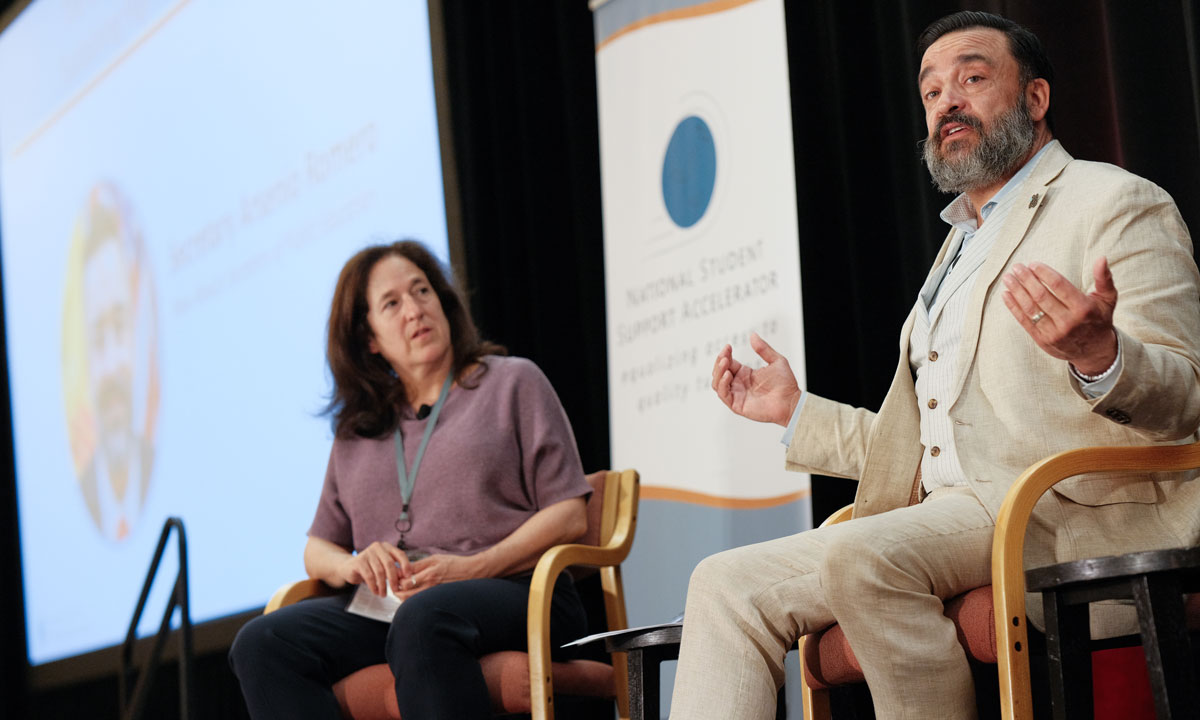
New Mexico education Secretary Arsenio Romero discussed tutoring with Stanford University researcher Susanna Loeb at a May conference. Notably, research by Susanna Loeb (Stanford University) revealed that tutoring methods and strategies can vary dramatically both in their design features and student outcomes. Loeb’s team of researchers discovered that in particular “high impact” tutoring strategies have demonstrated statistically significant effects on student learning in math and reading. High impact tutoring contains the following features:
- One-on-one tutoring (or with very small groups)
- Tutoring content is aligned with in-class instruction
- Students receive tutoring at least three times per week from the same tutor
- Tutors are professionally trained
Another study of more than 2,000 elementary school children in Texas tested the difference between one-to-one and two-to-one online tutoring during the 2022-23 school year. These were young, low-income children, in kindergarten through 2nd grade, who were just learning to read. Children who were randomly assigned to get one-to-one tutoring four times a week posted small gains on one test, but not on another, compared to students in a comparison group who didn’t get tutoring. First graders assigned to one-to-one tutoring gained the equivalent of 30 additional days of school. By contrast, children who had been tutored in pairs were statistically no different in reading than the comparison group of untutored children. A draft paper about this study, led by researchers from Stanford University, was posted to the Annenberg website in May 2024.
The IRC in Denver's Youth Education team is excited to announce the completion of their pilot program of Tutoring Together! The teams' interest in this particular program - with the goal to support client teens with their school work, English language acquisition, and adjustment to school expectations in the USA - was partly born out of feedback from a IRC in Denver Client Voice focus group, in which teens strongly advocated for their need of more personalized English language training.
- | The 74
Loeb & Safran: From Title I and Americorps to apprenticeships and renegotiated contracts with vendors, ways to find replacement funds and economize. strong>Multi-Tiered Systems of Support: Districts across the nation use Multi-Tiered Systems of Support to target appropriate interventions for students with learning, social, emotional, or behavioral difficulties. Many districts could improve these offerings by using a high-impact tutoring approach, making sure their interventions build relationships between students and educators that motivate, engage and target students’ growth areas using data and high-quality instructional materials. Schools can integrate high-impact tutoring with the funds already being used for MTSS by reallocating resources to more effective approaches.
As excitement grows around tutoring as a strategy to combat learning loss, advocates have rightly been encouraged by the growing body of evidence demonstrating the efficacy of tutoring interventions. To date, however, little research has examined the impact of fully virtual tutoring on very young students. Hardly a technicality, this distinction matters because younger children are less likely to have the technical and self-regulation skills upon which virtual learning depends. Now, a new study by researchers from Stanford, Vanderbilt, and UnboundED analyzes the benefits of virtual tutoring specifically for early elementary students.
Mays pointed to the move to focus federal pandemic relief money on tutoring programs whose design showed evidence of effectiveness, such as individual or very small groups, and using an aligned curriculum in sessions at least three times a week. This model differed from tutoring provided under the No Child Left Behind Act’s supplemental education services, which were repeatedly found to have no benefit for student achievement—in part because programs varied significantly from district to district.