Amanda Lu, Ayesha Hashim, Ev Fu Gilbert, Helen Zhou, Susanna Loeb
Introduction
Since the COVID-19 pandemic, tutoring has emerged as a major strategy for improving student outcomes. Building on a strong body of existing research, strategic system leadership, and deliberate policy action, districts across the country have implemented high-impact tutoring programs aligned with evidence-based structures. In this brief, high-impact tutoring refers to tutoring that is frequent, sustained, delivered individually or in small groups, and grounded in evidence-aligned instruction.1
Early implementation was supported by large investments from local, state, federal, and philanthropic sources as educators worked to mitigate the academic impacts of COVID-19. The largest of these investments was the Elementary and Secondary School Emergency Relief Fund (ESSER), a $190 billion federal investment to support school reopenings and address the educational impacts of the pandemic. As of March 2024, the Council of Chief State School Officers estimated that $4.4 billion of ESSER funds had been spent on tutoring and learning acceleration, with spending on tutoring increasing as districts shifted from pandemic triage to addressing student learning needs.2
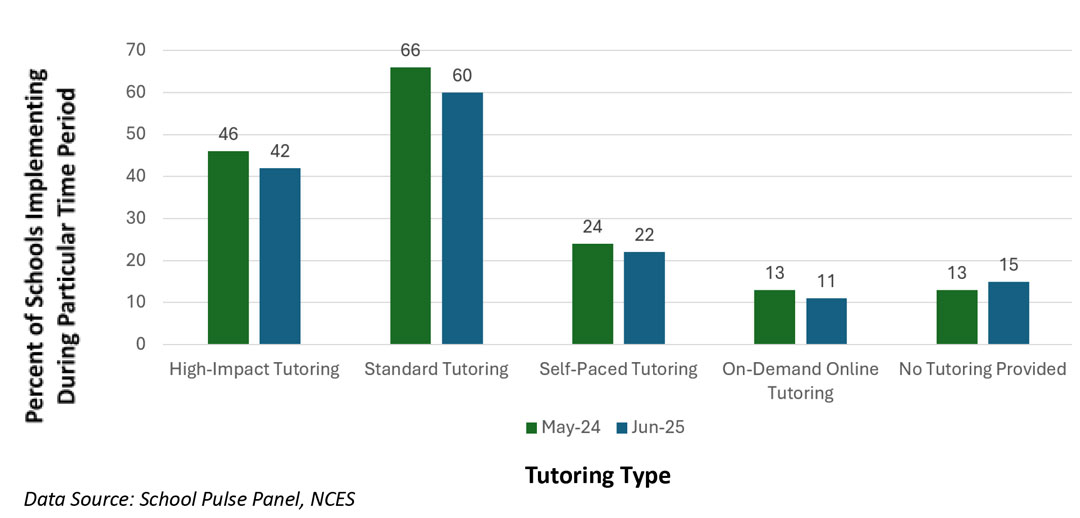
As ESSER funds were sunsetting, some speculated that the broader tutoring movement would stall because districts would be unable to sustain the costs of programs they had built. Disruptions in the tutoring provider market and pauses in district programs added to those concerns. In our analysis of nationally representative survey data from the School Pulse Panel (National Center for Education Statistics), we found that district tutoring activity decreased slightly as the window to access ESSER funds closed.3 However, those national trends offer only a partial picture. Rather than producing a uniform “tutoring cliff,” the end of ESSER appears to have created a sorting point, with districts pursuing different paths as they adjusted to a new funding reality.
Figure 1: Prevalence of District-Level Tutoring Offerings as the ESSER Window Closes
To better understand those divergent paths, we examined the trajectories of 35 district tutoring programs (discussed in greater detail in the following section). While some districts are experiencing significant disruptions and discontinuing tutoring all together, others are adapting their tutoring programs to fit post-ESSER conditions. This included refining programs to a more targeted and sustainable scale, integrating tutoring into existing support systems, developing lower-cost implementation models, maintaining programs at similar levels, or expanding them further. These varying trajectories suggest that sustainability is not simply a question of replacing ESSER dollars. Instead, districts are making strategic decisions about how tutoring fits within their long-term academic priorities, operational capacity, and available funding streams.
In this brief, we describe how districts are adapting their tutoring programs to sustain them beyond pandemic recovery and into long-term academic support structures for their students. We ask how districts responded to the end of ESSER funding and what strategies helped some continue tutoring despite the loss of temporary federal support.
We identify four interrelated strategies that affect a district’s ability to continue tutoring programs post-ESSER: 1) Advocating for tutoring using compelling data narratives; 2) Calibrating tutoring program scale for optimal results; 3) Integrating tutoring into other instructional supports and academic structures; and 4) Building site-level capacity and community partnerships that reduce the need to purchase higher-cost services.
In the analysis that follows, we first show the varied paths districts have taken post-ESSER with their tutoring programs. We then discuss the strategies that have helped districts preserve their tutoring programs even as primary funding sources expire, and we end with broader policy implications for sustaining effective tutoring programs across the country.
The many paths of tutoring programs post-ESSER
Given the abrupt end of ESSER funding, some predicted that the broader tutoring movement would slow. While district tutoring activity has declined slightly, a more granular district-level examination shows that districts are following a variety of post-ESSER paths, suggesting that the end of these funds does not necessarily undo progress that has been made. In our in-depth survey of 35 districts, we identified four distinct paths:
- Path 1: Districts experiencing a pause or disruption in their tutoring programs (23%, 8 out of 35 districts).
- Path 2: Districts significantly reducing the scale of their tutoring programs (23%, 8 of 35 districts).
- Path 3: Districts maintaining the scale of their tutoring programs (31%, 11 of 35 districts).
- Path 4: Districts increasing the scale of their tutoring programs (23%, 8 of 35 districts).
Although tutoring activity was discontinued in some districts, Paths 2 through 4 show that most districts in the sample did not abandon tutoring; they either reduced, maintained, or expanded programs as they adjusted to new fiscal conditions. In fact, these nearly even splits across pathways show that the ESSER cliff did not affect all districts in the same way; local capacity, funding options, program design, and evidence expectations shaped whether tutoring contracted, continued, or grew. As we detail more in our findings, a multitude of factors shaped a district’s post-ESSER path. Some districts were supported by state funding and local partnerships. Other districts preserved tutoring through successful advocacy efforts. These individual pathways serve as potential learning opportunities for other districts. The diversity of approaches for sustaining tutoring also reflects the number of ways that tutoring has been implemented across the country. Although ESSER may have been a common initial pool of resources, the autonomy given to districts to spend ESSER flexibly yielded a multitude of approaches to high-impact tutoring.
Strategies from districts that are sustaining tutoring programs
The strategies below focus on districts that continued tutoring in some form after ESSER, including those that reduced program scale while preserving a more targeted model. We synthesize our findings across four emerging strategies for sustaining ESSER-funded tutoring initiatives long-term.
Strategy #1: Data narratives help districts make the case for continued tutoring investment
District administrators often played an advocacy and storytelling role on behalf of their tutoring programs, particularly as ESSER-funded positions came under pressure, taking on a role we call a ‘district champion’. These champions translated implementation and outcome data into a clear case for why tutoring remained worth funding. A tutoring director from a large urban district described how their team utilized program impact data to secure support from a local philanthropic funder:
“[Funders] want to know how has their money impacted students and growth….You have to have good, accurate data…that really will help you see how your program is working. If we didn’t collect the data that we have over the past five years, you’re just dumping money into something that you don’t know how it’s impacting students.”
(Tutoring Director, Large Urban District)
Sustaining tutoring programs required active advocacy from district leaders and program staff, grounded in the ability to communicate a compelling data-driven narrative about program trajectory and impact. These narratives were important to decision makers and resource providers when allocating additional dollars to tutoring programs. Strong data systems and compelling data narratives supported both external fundraising and internal decision-making, enabling districts to communicate tutoring’s value, refine program design, and compete for internal or external funding in a more constrained fiscal environment.
Strategy #2: Right-sizing tutoring can strengthen implementation and make sustainability more realistic
Instead of making a binary decision about whether to keep or eliminate tutoring programs, districts asked themselves what size would be most effective and sustainable for their programs. For some districts, sustaining tutoring meant serving fewer students more consistently rather than preserving broader access with weaker implementation. District administrators described how scaling down tutoring programs after the ESSER funding cliff allowed for a more manageable and effective program size. A district leader from a large urban district highlighted how a smaller scale positively impacted their high-impact tutoring program’s value and effectiveness:
“The way we have [high-impact tutoring] structured now is…we’re being really strategic and very intentional about the schools…that we’re selecting [and] what we’re targeting in terms of education, academically…we’re really trying to meet a specific need…We do hold quite a bit of oversight. We progress monitor weekly and we watch [student] grades and we ensure that they’re taking quarterly assessments…it’s not about holding people accountable, yet it is holding people to a certain level of fidelity with [implementing] this program that we were unable to do when it was as large as it was [during ESSER]. It is now very manageable, and we can see the positive impacts.”
(District Manager of MTSS, Large Urban District)
While ESSER funding enabled rapid expansion to address broad academic disruptions, its expiration created space for districts to recalibrate tutoring programs around the needs that tutoring was best suited to meet. Districts that reduced the number of students served in response to funding constraints found that a smaller, right-sized program enabled more targeted instructional delivery, stronger implementation fidelity, and greater strategic alignment, while positioning high-impact tutoring models for long-term sustainability.
Strategy #3: Integrating tutoring into core academic support structures strengthens instructional coherence and program sustainability
Transitioning high-impact tutoring programs from a pandemic-era learning recovery intervention into an established practice required integration into existing instructional support frameworks, such as a district’s multi-tiered system of supports (MTSS) or response to intervention (RTI) model. An assistant director from a small suburban district explained how embedding high-impact tutoring within the district’s RTI system increased alignment and coherence across student supports:
“We have started a PLC [Professional Learning Community] with our Academic Acceleration group, and that’s all of our RTI interventionists and our lead tutors. We meet with them twice a month about how to ensure that we are at grade level standard…. Right now, we still have that [district-level] implementation coach—she does all the PLCs with our tutors and our interventionists—and it’s helped us to be more cohesive across all three schools, just bridging that gap between our interventionists and our tutors and our gen ed teachers.”
(Assistant Director of Schools, Small Suburban District)
Integrating tutoring into core academic support systems positioned high-impact tutoring as a coordinated component of a district’s intervention infrastructure rather than a standalone initiative. This integration strengthened alignment across tutors, interventionists, and general education teachers, while expanding the coherence and reach of student supports. District administrators also noted that embedding tutoring within existing intervention systems created more sustainable funding pathways, tying high-impact tutoring to federal, state, general fund, MTSS, or RTI-related funding structures.
Strategy #4: Local tutor pipelines and community partnerships can lower costs and build durable capacity
Districts that sustained their tutoring programs post-ESSER often leveraged local and state partnerships with universities, educator preparation programs, local funders, and community coalitions to build community-based program capacity. A district leader from a large urban district described how investing in a site-level tutoring pipeline led to a cost-effective, in-house tutoring model:
“So our focus programs are [a literary program] and our [tutoring program]. With [tutoring program]…we pay our high schoolers to tutor, but I can run the program for only $150K a year and have it still serving at six of our high schools [while] going to six of our elementary schools. So it’s a pretty cheap program that I’ve been able to pay through philanthropic dollars or small [state] grants…. Long term, I’m looking at trying to tap into pathways like [Career and Technical Education] dollars, because we’re getting these students to go into the teaching profession.”
(Executive Director of Student Opportunity, Large Urban District)
By sourcing tutors locally, the district reduced staffing costs and embedded its tutoring pipeline within smaller, more predictable funding streams. While building community partnerships may require greater upfront investment, these relationships can develop into more durable, community-engaged program structures. Districts that adopted in-house or hybrid high-impact tutoring models in response to the ESSER funding cliff demonstrate that program redesign—not just replacement funding—is a potential key to long-term sustainability.
Conclusion
The end of ESSER funding has not halted the tutoring movement, but it has changed the conditions for sustaining it. Districts are no longer operating in a period of large, flexible federal relief funding. Instead, they are making choices about where tutoring fits within long-term academic support systems, how large programs can realistically be, and what evidence is needed to justify continued investment.
The districts that continued tutoring did not simply replace ESSER dollars. They adapted. They used data narratives to communicate value, right-sized programs to strengthen implementation, embedded tutoring within MTSS and RTI systems, and built partnerships or local tutor pipelines to reduce costs. These shifts suggest that the future of high-impact tutoring depends not only on continued funding availability, but on whether districts have the infrastructure, evidence systems, and flexibility to implement tutoring well.
The experiences of districts from our survey and interview sample that discontinued, paused, or greatly scaled down their programs offer an important counterpoint to the sustainability stories highlighted throughout this brief. These districts frequently reported high vendor costs, limited capacity to build in-house tutoring models, weaker systems for documenting program outcomes, and difficulty producing the type of evidence needed to secure ongoing funding. They also faced increasing pressure to justify tutoring investments amid competing budget priorities and an unpredictable funding landscape. These findings suggest that sustaining tutoring depends on more than replacing ESSER dollars. It requires the organizational infrastructure, data capacity, leadership support, and funding flexibility necessary to adapt tutoring to post-ESSER conditions. Districts that lacked those conditions were substantially more vulnerable to program disruptions.
For policymakers and funders, the lesson is clear: sustaining tutoring requires predictable and flexible funding, support for district capacity-building, and evidence expectations that encourage continuous improvement. If these conditions are in place, tutoring can move from a temporary pandemic recovery strategy to a durable component of academic support for students.
Appendix 1: Data and Methods
This project utilized three data sources to provide a national-level and district-level understanding of trends in the take-up of tutoring programs in public schools across the country.
The first of these data sources was the School Pulse Panel (SPP), which is a survey administered by the National Center of Education Statistics and the U.S. Census Bureau developed during the COVID-19 pandemic to monitor learning recovery efforts in public schools across the country. The survey continues to collect real-time information on trends and challenges within schools. The panel has historically contained questions about learning recovery and tutoring. We utilize SSP survey results from administrations in December 2022, October 2023, May 2024, October 2024, and June 2025 to inform our analysis. Successive survey administrations did not always contain the same questions resulting in a limitation of using this data to synthesize descriptive trends.
The second data source was a survey we administered to school districts. This was a more in-depth survey that we circulated to districts within the National Student Support Accelerator’s network and within target states (CA, TN, CO, and TX). We had issues with responsiveness and did not achieve our target sample of 100 districts. In response, we extended our survey window and did more direct outreach to districts within our network. Despite these recruitment challenges, we gathered rich data that allows us to better understand the variety of ways in which districts are structuring, supporting, and funding their tutoring programs after the end of ESSER. A relative strength of this survey is the districts in our sample are more racially diverse than the average U.S. school district and contain districts and charter networks of various sizes.
Our third data source was a set of qualitative interviews we administered with tutoring administrators from 15 school districts in our survey sample and one district outside of the survey sample with a discontinued tutoring program. These interviews ranged from 30 minutes to an hour, with the average interview lasting around 45 minutes. In these interviews, we asked district administrators to narrate their district tutoring program’s path in relation to the availability of ESSER funds. We also asked district administrators about how they perceived the value of their programs, how they made plans for sustaining tutoring programs after ESSER, and what was needed to enact these plans. Informed by the data from our NSSA-administered survey, we ensured that our interview sample contained districts of different size and with differing paths after the ESSER cliff.
1 Robinson, C. D., & Loeb, S. (2021). High-impact tutoring: State of the research and priorities for future learning. National Student Support Accelerator, 21(284), 1-53.
2 Council of Chief State School Officers. (2024, March 20). Investment to impact: Leveraging ESSER and keeping what works. https://learning.ccsso.org/investment-to-impact-leveraging-esser-and-keeping-what-work
3 See Appendix 1: Data and Methods for a breakdown of all three data sources used.