A Tutor Registered Apprenticeship Program (TAP) can play a critical role in a high-impact tutoring program by supplying trained tutors, supporting tutor coaching and development, and expanding funding opportunities. Learn more about whether this approach is a good fit for your organization by exploring the following sections:
What is a Registered Apprenticeship Program (RAP)?
Can an AmeriCorps Program become a RAP?
It is possible for AmeriCorps grantees to combine AmeriCorps and Apprenticeship programming, but combining requires working with both your AmeriCorps team and your ATR to ensure all requirements are met. See ServeColorado’s Americorps and Apprenticeships guidance including the Registered Apprenticeship and Americorps: a Case Study in Workforce Development and additional guidance from AmeriCorps.
Apprenticeship is a centuries-old model for learning a skill, trade, or profession through hands-on, on-the-job training guided by a skilled mentor, often paired with structured instruction over a set period of time or until the apprentice masters specified competencies to prepare apprentices for successful careers. While this model remains popular globally, it is experiencing rapid growth in the United States, with approximately 680,000 apprentices in 2025—an 88% increase over the past decade.
In the U.S., the Registered Apprenticeship Program (RAP) is an employer-driven model of experiential learning that follows an “earn and learn” approach. Regulated by the U.S. Department of Labor or State Apprenticeship Agencies, RAPs combine paid, on-the-job training with related instruction to build essential skills, raise wages, and provide employers with the talent they need to succeed.
This increase in RAPs is fueled by two key factors: persistent labor shortages in critical industries, such as education, and the rising cost of higher education, which makes the “earn while you learn” model increasingly attractive. In June 2025, a national effort launched to reach the goal of 1 million registered apprentices in the United States.
Education is a leading area of RAP growth. Strategies to leverage RAPs for teacher training are expanding rapidly, with 37 states and territories now offering K–12 teacher apprenticeship programs—up from just two states in 2022. As of May 2024, there are over 100 K–12 teacher RAPs nationwide, supporting the training of more than 3,000 teacher apprentices.
The U.S. DOL (Apprenticeship USA) provides additional resources to better understand registered apprenticeship programs including A Quick-Start Toolkit: Building Registered Apprenticeship Programs. Specifically, the Code of Federal Regulations, Title 29, Parts 29 (Subpart A) and 30 govern registered apprenticeship programs.
How does a RAP Work?
A RAP has five key components as outlined in U.S. DOL: Quick Start Toolkit: Building Registered Apprenticeship Programs:
- Employer involvement
- Structured, on-the-job training
- Related instruction
- Wage increases based on competency mastery
- National credential
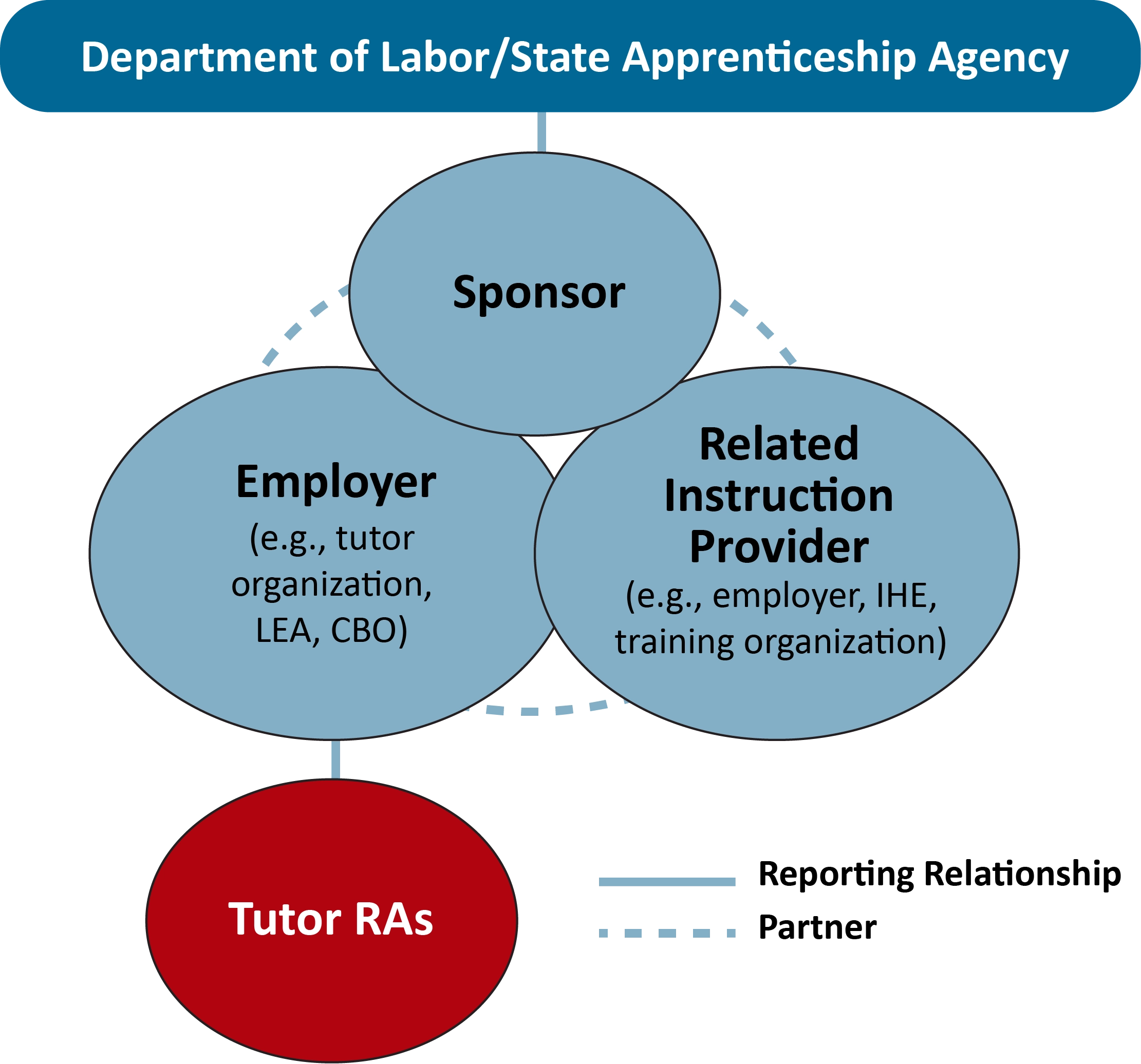
These components are provided through three distinct roles (Sponsor, Employer, Related Instruction Provider) as outlined below. An organization can play one, two, or all three roles in a RAP.
Registered Apprenticeship Program Roles
| Title | Purpose/Role | NJTC Example | Additional Examples |
| Sponsor | Works closely with the U.S. DOL Apprenticeship Department or State Apprenticeship Agency to apply for and register the RAP. Administers the RAP, ensuring it complies with regulations and standards. Sponsors can be a single employer (e.g., LEA, tutoring provider, CBO), a state level organization, or an institute of higher education. | New Jersey Tutoring Corps is the sponsor for their TAP. | A state education agency may sponsor one or more TAPs. An institution of higher education may sponsor one or more TAPs. An LEA may sponsor their own internally operated TAP. A for-profit or nonprofit tutoring provider may be a sponsor. |
| Employer | Identifies the competencies that tutor apprentices must learn, recruits, hires and employs tutor apprentices, provides on-the-job training through an experienced mentor or coach, pays progressively higher wages as competencies are mastered. | New Jersey Tutoring Corps is the employer of their tutor apprentices. | An LEA may be the employer of their tutor apprentices. A for-profit or nonprofit tutoring provider may be the employer of their tutor apprentices. |
| Related Technical Instruction Provider | Develops and delivers curriculum for related technical instruction (RTI) to support apprentice mastery of required competencies. If the RTI provider is an institution of higher education, it may provide college credit for courses successfully completed. | ConnectED Workforce and New Jersey City University provide RTI for NJTC’s tutor apprentices. | An institution of higher education may provide RTI while also providing college credit. Training organizations may provide RTI. The employer may provide RTI for their tutor apprentices. |
Special Cases
- AmeriCorps and Apprenticeships - It is possible for AmeriCorps grantees to combine AmeriCorps and Apprenticeship programming, but combining requires working with both your AmeriCorps team and your ATR to ensure all requirements are met. See ServeColorado’s Americorps and Apprenticeships guidance including the Registered Apprenticeship and Americorps: a Case Study in Workforce Development and additional guidance from AmeriCorps designed (in part) to expand access to workforce development opportunities.
- Multi-state Operations - It is possible to create a National Registered Apprenticeship Program. If your organization operates in multiple states, consult the ATRs in those states to determine how National Apprenticeship Program registration affects funding and benefits. Use their guidance to decide whether a National RAP is appropriate for your organization. While national registration simplifies approval, some state apprenticeship funding requires state-level registration.
- Pathway to Educator Apprenticeship Programs - If your program intends to provide a pathway to another education-related apprenticeship, begin by identifying target programs using these resources: Apprenticeship Education Programs, K-12 Registered Teacher Apprenticeship Compendium, Registered Teacher Apprenticeship Programs: A 50 State Scan, and Educator Registered Apprenticeships: Funding Profiles for Five Programs. Once identified, collaborate with the receiving program to establish advanced standing agreements that ensure a clear pathway for tutor apprentices continuing beyond your TAP.
Degree Apprenticeship - Your organization may consider creating a degree apprenticeship program which combines paid, on-the-job learning with related college coursework at a higher education institution, allowing apprentices to earn a degree while gaining real-world experience. To learn more about this emerging approach, see Creating Pathways to College Degrees Through Apprenticeships and Community Colleges and Apprenticeship: The Promise, the Challenge.
New high-impact tutoring programs - If your organization is launching a new high-impact tutoring program while pursuing a TAP, aligning these efforts can be valuable, but will require careful planning, coordination, and adequate resourcing.
Why consider a Tutor Registered Apprenticeship Program (TAP)?
Sourcing, developing, and retaining high-quality tutors and securing funding are often the greatest challenges for tutoring programs. A TAP can be a vital component of a high-impact tutoring program, providing a sustainable source of high-impact tutors, ensuring tutors receive the training and coaching needed to be effective, and unlocking potential for workforce development funding.
Additionally, the New Jersey Tutoring Corps offers the first example of a successful TAP, and the U.S. Department of Labor approved National Guideline Standards for Tutor Registered Apprenticeships, streamlining registration for new TAPs.
For employers (e.g., LEAs, tutoring providers, for-profit, and nonprofit organizations), a Tutoring RAP offers:
- Potential funding support – Expands access to funding for tutor wages and training, including both on-the-job coaching and related instruction. In fact, in June 2025, $84 million in new RAP funding was released to support programs across all 50 states. Please note that apprenticeship funding is competitive and varies by state. Annual state apprenticeship resources and priorities change, which can affect your program’s eligibility and access to funding.
- Recruitment and retention advantages – Enhances hiring and retention by offering tutor apprentices high-quality training and a nationally recognized credential.
- Research-aligned tutor development – Establishes a clear pathway to train effective tutors using competencies grounded in evidence-based, high-impact tutoring practices.
- Educator workforce development - Strengthens the overall education talent pipeline.
For tutors, a RAP offers:
- Career pathway with financial stability – Provides an accessible on-ramp to a career in education while earning a living wage. According to a 2024 Gallup Poll, 87% of respondents cited cost as the primary reason for not enrolling in college, making RAPs an affordable alternative.
- Comprehensive training and support – Combines in-depth, on-the-job training with related instruction and ongoing coaching to build valued skills.
- Nationally recognized credential – Awards a credential based on in-demand competencies such as relationship building, data analysis, instruction, and more, supporting long-term career growth.
Why High-Impact Tutoring?
Tutoring can be defined in many ways, many of which are not highly effective. A large body of research indicates that effective tutoring (referred to throughout this Toolkit as High-Impact Tutoring) has specific characteristics including occurring multiple times per week, with a consistent, well-trained and supported tutor, using student data to inform tutoring sessions, and high-quality instructional materials that are aligned with the student’s core education program.
High-Impact Tutoring is relationship-based, intensive, individualized instruction that leads to substantial learning gains for students by supplementing (but not replacing) students’ classroom experiences. Research indicates that effective tutoring programs 1) have tutors that are well-trained and supported; 2) occur multiple times per week for an age appropriate amount of time individually or in small groups of no more than three students; 3) use student academic progress data to design tutoring sessions; 4) use high-quality materials that are aligned with the student’s core instruction; and 5) occur at school during the school day whenever possible.
High-Impact Tutoring: Intensive, Relationship-Based, Individualized Instruction
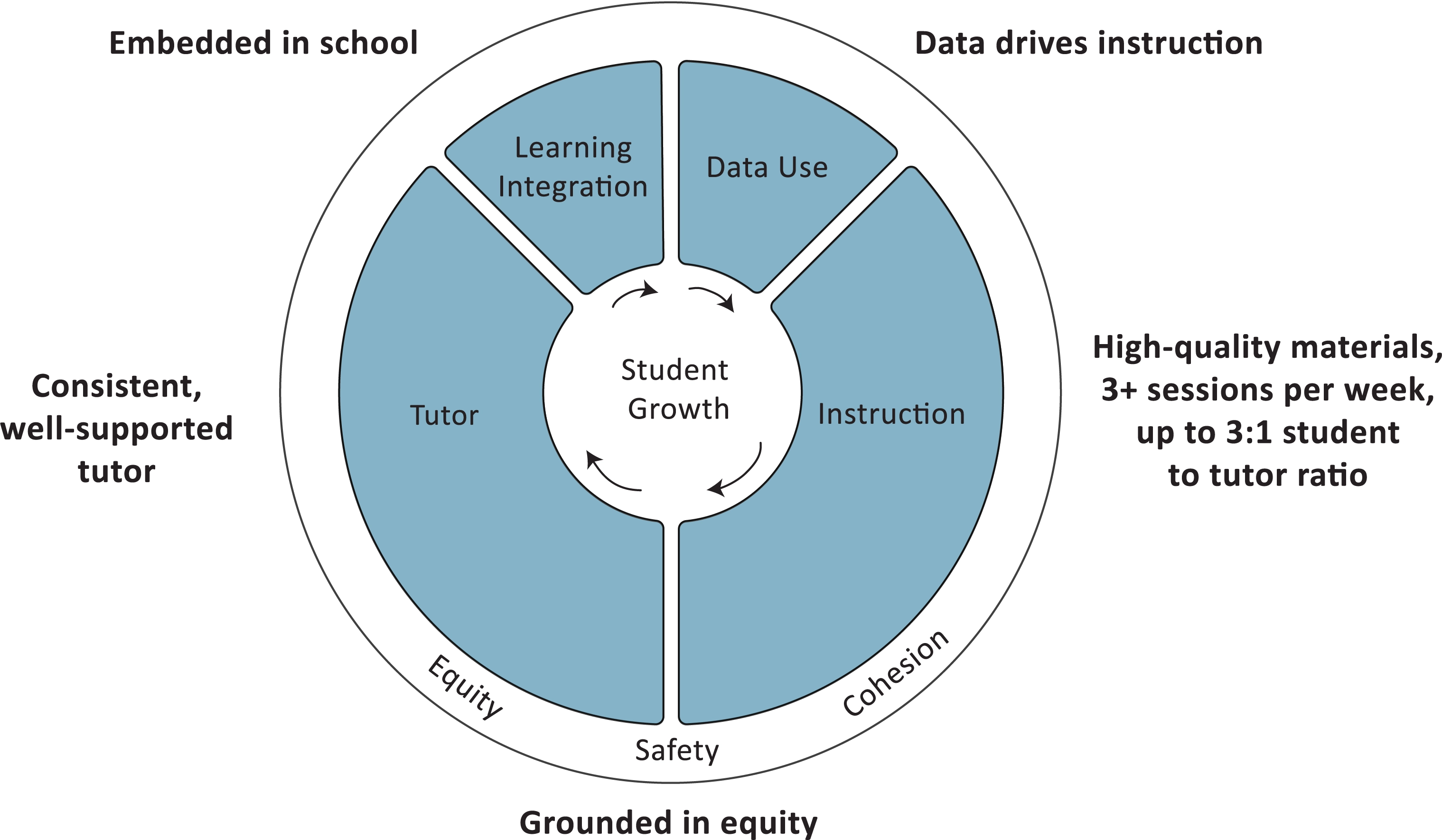
*Important Application Guidance: The term “Grounded in Equity” is used in this graphic as part of the broader high-impact tutoring framework. When preparing materials for U.S. DOL or state apprenticeship submissions, translate this into compliance-oriented language (e.g., “expanding access,” “reducing barriers,” “supporting various pipelines”).
How does a TAP differ from employing tutors typically?
| Activity | Typical High-Impact Tutoring Program | High-Impact Tutoring RAP |
| Tutor Recruitment and Hiring | Managed by tutoring program
| Managed by tutoring program (employer) Must hire as an employee (W-2) Must provide RAP for the length of the apprenticeship time (approximately two years for TAP) Able to offer nationally recognized credential as a benefit over other tutoring programs Must register and report progress for each tutor apprentice in RAPIDS (the federal database for apprenticeship programs) or their state's apprentice system |
| Tutor Training | Determined by tutoring program Focused on competencies required for high-impact tutoring including relationship building, data analysis, instruction skills, etc. | Determined by tutoring program Focused on competencies required for high-impact tutoring including relationship building, data analysis, instruction skills, etc. Reported via RAPIDS or their state's apprentice system Administered by or in partnership with the Related Instruction (RTI) provider |
| Tutor Coaching | Determined by tutoring program Focused on competencies required for high-impact tutoring including relationship building, data analysis, instruction skills, etc. | Determined by tutoring program Focused on competencies required for high-impact tutoring including relationship building, data analysis, instruction skills, etc. as required by the RAP’s approved Work Process Schedule Reported via RAPIDS or their state's apprentice system |
| Tutor Credential | None | Nationally recognized credential upon mastery of competencies |
| Tutoring Program Design including high-impact tutoring elements of Instruction, data, learning integration, etc. | Align with High-Impact Tutoring Standards | Align with High-Impact Tutoring Standards |
| Funding | Funded through federal or state education funds, philanthropy, or other education related funding (e.g., AmeriCorps, Federal Work-Study) | In addition to education sources and philanthropy, RAP’s may apply for apprenticeship grants that can be used to support tutor wages, coaching, and training |
Should your organization consider a TAP?
Below are important considerations to help guide your organization’s decision to pursue a TAP. Although your organization may not yet have clear answers to each question, you should be fairly confident in a positive response to each question before committing significant time to designing a TAP.
TAP Readiness Assessment
| Is your organization or a potential partner organization: | Response/Reflection | If not, what other ways are there to meet this need? |
Aware of and well positioned to be awarded registered apprenticeship grants for a tutor apprenticeship in the state(s) in which you intend to operate? (see Apprenticeship Funding Opportunities)
| ||
| Committed to providing evidence-based tutoring and employing tutors for a minimum of two years (the expected time required to master the apprentice competencies)? | ||
| Able to commit to paying at least one increase in wages based on mastery of competencies? | ||
| Committed to building the partnerships (sponsor, employer, RTI provider) required for a successful TAP including providing the on-the-job training and related instruction required for tutor apprentices to be successful? | ||
| Committed to developing the skills and knowledge of your tutors consistent with TAP competencies (see competencies in the Work Process Schedule in the Tutor National Guideline Standards noting that competencies may be revised for local context)? | ||
| Does your organization or a potential partner organization: | ||
| Have the capacity to apply for a TAP? (estimated time for completion ranges widely based on the extent to which your systems are documented and can be translated to the RAP format; a minimum of 15 hours) | ||
| Have the capacity to apply for and manage apprenticeship grants? | ||
| Have the capacity to comply with administrative requirements of a TAP? (Administrative reporting is primarily the responsibility of the Sponsor. Estimated time fluctuates (e.g., more time intensive while registering apprentices) with an average of approximately 5 hours per apprentice per month.) |
Additional Resources
Tutoring Program Development Resources
- National Student Support Accelerator - research, tools and guidance support for developing and implementing a high-impact tutoring program
Tutor Apprenticeship Program Resource
- Tutor National Guideline Standards
Apprenticeship Program Resources
- Apprenticeship USA - official U.S. Department of Labor website guidance and resources
- Apprenticeships for America - resources, best practices, and updates on the Apprenticeship field